

Sam Frost got banned from Meta for changing his credit card.
That’s it. His bank issued a new card for fraud protection. Meta tried to charge the old one, failed, and decided Sam was running a scam. Account restricted. Appeals denied. 60 days gone.
“It’s not about if it happens,” Sam wrote later. “It’s about when.”
If you’re advertising crypto, gambling, or cannabis, you’re already playing with a loaded deck. Here’s what happened in 2024:
Google blocked 193.7 million crypto ads
Only 40% of crypto ads get approved on Google, 50% on Meta
85% of countries now ban gambling ads
$208.6 billion in lost ad reach for gambling operators
These aren’t random bans. Platforms see your entire industry as high-risk, and they’ve built a system to catch you.

THE THREE RISK TIERS
TIER 1: INSTANT BAN (The Untouchables)
These categories trigger immediate permanent suspension. No warnings. No appeals. No “but you didn’t know.”
What’s on the list:
Weapons & Explosives: Guns, ammunition, knives marketed as weapons, bomb-making materials
Illegal Drugs: Cocaine, heroin, meth, fentanyl, or anything promoting their use
Counterfeit Goods: Fake designer handbags, replica watches, knockoff electronics
Adult Sexual Services: Escort services, sexual enhancement drugs without prescription, adult content
Unregulated Pharmaceuticals: Prescription drugs sold without valid prescriptions
Why these are different:
Platforms face massive legal liability here. We’re talking federal crimes, trademark lawsuits, and potential harm to users. There’s no amount of compliance that moves you out of Tier 1.
A weapons manufacturer with all proper licenses? Still banned from advertising. A prescription drug with FDA approval? Can’t advertise unless you’re a verified pharmacy chain.
The enforcement:
Automated filters catch these instantly
Domain gets blacklisted across the platform
All linked accounts get flagged
Ban is permanent, appeals are automatically rejected
Real example: Someone tried advertising “replica designer watches” as “inspired by luxury brands.” Account terminated within hours, Business Manager banned, domain blacklisted. Three years later, they still can’t advertise on Meta.
TIER 2: PROBATION MODE (Where You Live)
You’re not banned, but you’re not trusted either. Think of it as advertising with an ankle monitor. Every move is watched, every ad gets extra scrutiny, and one wrong step sends you to ban-land.
CRYPTO: The Compliance Gauntlet
What you need to even get started:
1. Government Registration:
EU: MiCA-compliant licensing (new requirement as of April 2025)
Other countries: Equivalent regulatory approval
2. Platform-Specific Certifications:
Google: Crypto advertising certification (separate application)
Meta: Written permission after documentation review
Each platform takes 3-6 weeks minimum to approve
You reapply every 12 months
3. Strict Content Rules:
Can’t mention ICOs (Initial Coin Offerings)
Can’t promote DeFi protocols
Can’t advertise unregistered tokens or securities
Can’t promise any specific returns
Must include risk disclaimers on every ad
The reality check:
First-time crypto advertisers face significant rejection rates. Even with perfect paperwork, platforms might still say no.
Why? Last year, $9.9 billion was stolen in crypto scams. 62% of token launches fell under securities laws but weren’t registered properly. UK regulators rejected 90% of crypto ad applications due to poor anti-money laundering controls.
Platforms are absolutely terrified of enabling the next FTX scandal, the 2022 collapse of the $32 billion cryptocurrency exchange where founder Sam Bankman-Fried was convicted of defrauding customers out of billions of dollars and sentenced to 25 years in prison.
What gets you banned:
Advertising before certifications are approved
Landing page doesn’t show required risk disclosures
Promoting a new token without securities registration
Using urgency tactics (”Only 24 hours left to invest!”)
Geographic targeting to countries where you lack licensing
Approval rates by platform:
Google: 40% of crypto ads approved
TikTok: Less than 5% (basically impossible)
Reddit: Case-by-case, extremely selective
GAMBLING: The Geographic Minefield
What you need:
1. Licensing (The Complicated Part): You need a valid gambling license for every single country you advertise in. Not one license, one per country.
UK license doesn’t work in Spain. Nevada license doesn’t work in New Jersey. And 35+ countries ban gambling advertising completely no matter what licenses you hold.
2. Platform Requirements:
Age verification systems documented
Responsible gambling disclaimers on every ad
Disclaimers on landing pages
Self-exclusion options clearly visible
Problem gambling helpline numbers displayed
3. Absolute Prohibitions:
No remarketing: You cannot target people who previously visited your site or played your games. Ever. All platforms ban this.
No “risk-free” claims: Banned industry-wide after DraftKings got regulatory heat
No one under 25: Even in markets where 18+ gambling is legal, platforms won’t let you target anyone under 25
No odds or returns: Can’t mention specific odds, payout percentages, or “guaranteed wins”
The reality check:
85% of global markets now block gambling ads completely. That’s not “restricted”, that’s total bans.
In 2025, major gambling operators lost $208.6 billion in potential advertising reach due to new restrictions. Countries that allowed gambling ads three years ago? Many banned them entirely now.
Why platforms are paranoid:
Gambling addiction lawsuits. Underage gambling scandals. Regulatory fines that reach hundreds of millions of dollars. Platforms would rather lose your ad revenue than risk a Congressional hearing.
What gets you banned:
Creating lookalike audiences from customer lists (that’s remarketing)
Advertising in banned countries, even accidentally
Missing responsible gambling disclaimers
Promoting “beginner bonuses” that sound too risk-free
Using testimonials (”Someone won $10,000!”)
Any ad that could appeal to minors (bright colors, game-like imagery)
The 35+ banned countries expanded from just 12 in November 2025, now including major markets across Asia, the Middle East, Africa, and parts of Europe.
CANNABIS/CBD: The Schedule I Contradiction
What you need:
1. Certifications:
LegitScript certification (required by Meta, costs money, takes weeks)
State business licenses for cannabis/hemp
Lab testing results showing exact THC content
Compliance documentation for every state you target
2. Product Restrictions:
Non-ingested products only: Topicals, lotions, balms = okay (maybe)
Nothing you eat or drink: No tinctures, gummies, beverages, vape products
THC levels must be legal: 0.3% federally, but some states allow 0.5%, some allow 0%
Hemp vs. Cannabis matters: Different review processes depending on terminology
3. Creative Restrictions:
Zero plant imagery: No cannabis leaves, no marijuana plants, not even hemp plants
No health claims: Can’t say “reduces anxiety,” “relieves pain,” “helps you sleep”
No medical condition targeting: Can’t target people interested in “chronic pain” or “insomnia”
No implied drug use: No smoking imagery, no “420” references, no counterculture aesthetics
The reality check:
Federal law still classifies marijuana as Schedule I. This creates chaos because state laws conflict with federal law constantly.
What’s legal in California might be illegal federally, which means platforms, operating nationally, default to the strictest interpretation.
Platform-by-platform breakdown:
Meta:
CBD topicals only
LegitScript certification mandatory
No ingested products
Must target 18+ minimum (they recommend 21+)
Google:
Prohibits most cannabis advertising
Only allows FDA-approved pharmaceuticals (like Epidiolex)
CBD advertisers need pharmaceutical licensing
TikTok & Reddit:
Totally banned
Don’t even try
Taboola:
Hemp-based products only
Must be non-ingested
Case-by-case approval
Extensive documentation required
What gets you banned:
Showing a cannabis leaf (even stylized, even for legal CBD)
Ad copy says “CBD for anxiety relief” (health claim)
Product is a gummy or tincture (ingested = rejected)
THC percentage doesn’t match state requirements
Targeting by medical conditions
Landing page shows plant imagery
Example: An ad for CBD lotion got banned because the landing page showed a hemp plant in the background photo. Not the product itself, the decorative background image. That’s how strict this is.
TIER 3: EXTRA SCRUTINY (The Trust Issues)
These aren’t officially “restricted,” but platforms watch them like hawks because they have high fraud rates, addiction potential, or history of scams.
Industries that get extra scrutiny:
1. Supplements & Weight Loss:
High rate of false health claims
Tons of “miracle cure” scams
Platforms pre-reject anything promising specific results
Before/after photos require disclaimers
Any mention of disease treatment = instant rejection
Why: The FTC fines companies millions for false supplement claims. Platforms don’t want to be named in lawsuits.
2. Financial Services:
Forex trading, investment platforms, loan services
Requires licensing in most states
High scam rates (”get rich quick” schemes)
Strict income/return disclaimers required
Can’t promise guaranteed returns
Why: Financial scams cost consumers billions. Regulatory agencies actively monitor advertising.
3. Dating Services:
Age verification required
Safety features must be documented
Can’t make guarantees (”find your soulmate”)
High complaint rates about catfishing/scams
Why: Safety concerns, underage user risks, exploitation potential.
4. Crypto Education/Courses:
Gets confused with Tier 2 crypto advertising
“Learn to trade crypto” courses trigger same flags as crypto exchanges
Need disclaimers that you’re not providing financial advice
Can’t show income screenshots
Why: Platforms assume you’re sneaking around crypto advertising restrictions.
5. Real Money Gaming (Not Gambling):
Skill-based games with cash prizes
Daily fantasy sports in some jurisdictions
Sweepstakes with prizes
Gets confused with gambling constantly
Why: The line between “skill gaming” and “gambling” is blurry legally.
What “extra scrutiny” actually means:
Longer review times: Your ads sit in review for 48+ hours instead of 24
Higher rejection rates: Reviewers are more cautious, reject when unsure
Manual review required: Automated approval almost never happens
Account monitoring: One complaint triggers full account audit
Feedback score matters more: Low engagement or complaints = account restriction faster
How you know you’re in Tier 3:
Your ads consistently take longer to approve
You get rejected for “minor” policy violations others seem to get away with
Appeals take forever and often get generic rejections
Customer complaints result in immediate account review
The strategy for Tier 3:
Overcommunicate. Submit extra documentation. Use conservative ad copy. Avoid anything that could be interpreted as a health claim, financial promise, or guarantee. Assume reviewers are looking for a reason to reject you, because they are.
What Each Platform Allows:
Crypto sees mixed acceptance across platforms. Meta allows it with 50% approval rates, Google sits slightly lower at 40% approval, Reddit handles it on a case-by-case basis, and TikTok makes it nearly impossible to advertise.
Gambling is heavily restricted everywhere. Meta geo-limits it and only permits CBD topicals, Google has banned it across 35+ countries, Reddit bans it outright, and TikTok does the same.
Cannabis is the most universally prohibited category. Meta restricts advertising to CBD topicals only, Google mostly prohibits it, Reddit bans it entirely, and TikTok also bans it across the board.
HOW YOU GET CAUGHT
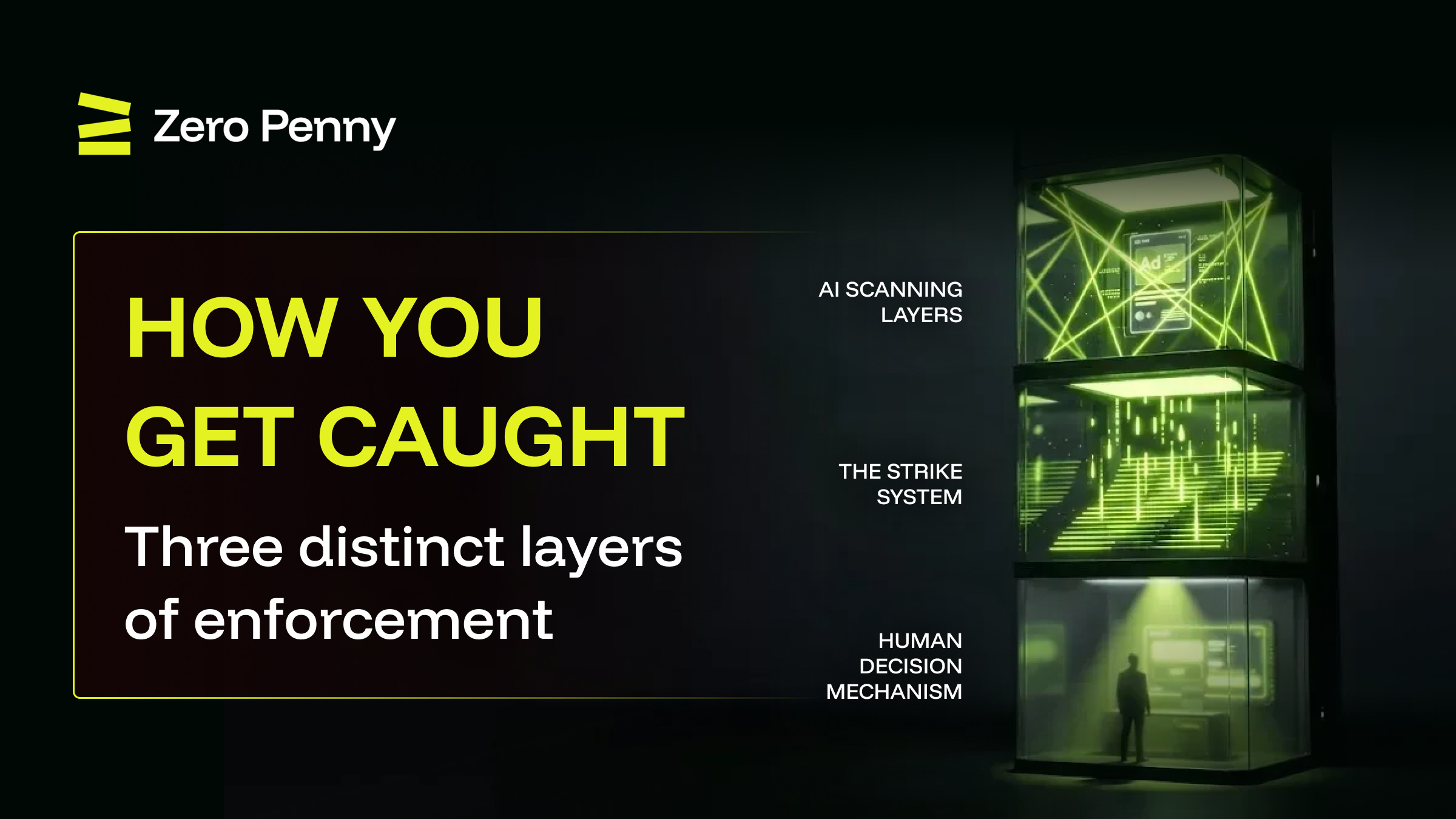
You hit “submit” on your ad and it disappears into a black box. Most advertisers think there’s a person on the other end clicking “approve” or “reject.” That’s not how it works anymore. Every ad goes through three distinct layers of enforcement, automated scanning, violation tracking, and human review, each designed to catch different types of problems. Understanding this process is the difference between getting approved on your first try and getting banned before anyone even sees your ad.
THE ROBOT LAYER
Before humans see your ad, AI scans:
Keywords (”guaranteed returns,” “ICO”)
Images (cannabis leaves, gambling)
Landing pages (does it match your ad?)
Account behavior (payment failures, spending spikes)
IP address (VPN usage)
Real story: “Someone added a new credit card. The system called it ‘suspicious payment’ and banned them instantly. No warning.”
THE STRIKE SYSTEM
Platforms keep score. Reddit gives warnings, then temporary bans, then permanent. TikTok? Straight to permanent for serious violations. Taboola? One cloaking attempt = account terminated.
The worst part: Strikes accumulate over time. Platforms track violation history, and past infractions count against your account health, some advertisers report that violations from years ago still impact their approval rates.
THE HUMANS
You get human review when you’re spending big, your licensing is complex, or someone reported you. Takes 3-7 days for appeals, longer for crypto/gambling.
Problem? Reviewers reject when unsure. Your approval depends on who reviews it that day.
HOW TO SURVIVE
BEFORE YOU LAUNCH
Crypto:
Get FinCEN registration first
Start certifications early (weeks, not days)
Set up geo-fencing
Expect significant rejection rates
Gambling:
License for each country
Check 35-country ban list
No remarketing plans
Accept 85% of markets are closed
Cannabis:
Get LegitScript certified
Non-ingested only
Document THC limits
Zero plant imagery
STAY PROTECTED
1. Diversify Platforms One ban shouldn’t kill your business. Use crypto-specific networks (Coinzilla, Bitmedia), gambling-friendly platforms, native ads.
2. Document Everything Licensing renewals, certifications, support conversations. When you get banned, documentation is your only defense.
3. Monitor Policy Changes
Meta Business Help Center
Reddit Ads Policy Updates
TikTok Business Blog
Major 2025 changes: Google’s MiCA compliance (April), expanding gambling restrictions, new certifications.
4. Use Platform Tools
Meta: Account Quality Center
Reddit: Work with Sales Rep
TikTok: Pre-submission review

CONCLUSION
Platforms don’t ban you to be difficult. They ban you because you represent legal liability.
Every crypto scam that runs on their platform? Potential lawsuit. Every underage gambler who sees your ad? Regulatory fine. Every health claim that turns out to be false? Congressional hearing.
$9.9 billion was stolen in crypto scams last year. 85% of global markets now block gambling ads completely. $208.6 billion in advertising reach lost by gambling operators in 2025.
Platforms tightened restrictions because the alternative, being blamed for the next FTX scandal, costs more than losing your ad revenue.
Once you understand their risk calculations, bans become predictable. You can structure campaigns that pass automated review, get proper certifications before launch, and build account health that survives policy changes.
While competitors create new accounts after their third ban (which gets them permanently suspended), compliant advertisers scale uninterrupted.
One ban can kill your business if you’re depending on one platform. One permanent suspension can blacklist your domain across the entire ad ecosystem. You don’t get unlimited chances.
Don’t just take our word for it. Zero Penny has helped clients recover from Meta bans and scale gaming campaigns, navigate WhatsApp restrictions with 47% lower costs, and conquer platform limitations in restricted verticals. Read our case studies to see exactly how we keep restricted advertisers online and profitable.

SOURCES
Official Platform Policies:
Industry Analysis: